

Forex
+100 Assets
Content table
1 month ago
5 Minutes read
Written by Greenup24

The economic calendar is an essential tool for Forex, gold, index and cryptocurrency traders. However, using it incorrectly can create a false sense of security and leave traders exposed to unexpected volatility.
One of the most common mistakes is filtering the calendar to display only high impact events while completely ignoring those classified as low or medium impact. Most calendars use colours such as yellow, orange and red to indicate the expected importance of each release, but these labels do not always reflect an event’s true market moving potential.
Markets do not move because an event has been assigned a particular colour. Prices move when new information changes existing expectations.
Economic calendars generally classify events according to their historical impact on volatility. This approach can be useful as a starting point, but it does not fully account for changes in the economic and market environment.
A central bank speech, for example, may be classified as a low impact event. However, if an influential policymaker makes an unexpected comment about inflation, interest rates or future monetary policy, the speech could trigger a significant market reaction.
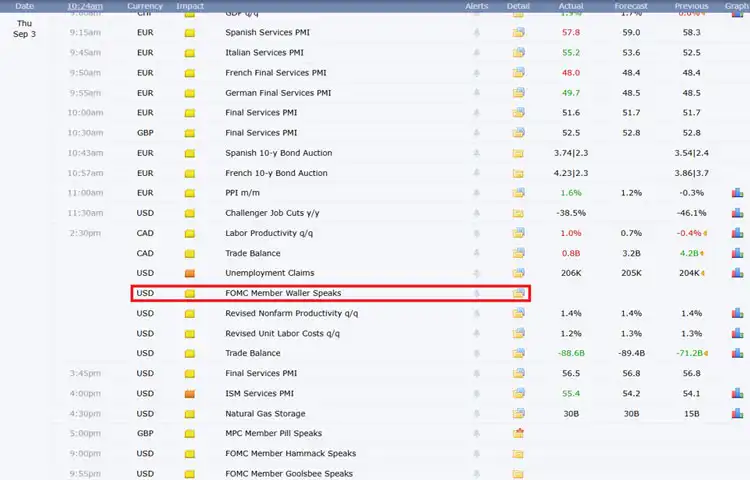
Meanwhile, a traditionally important release such as the US employment report may generate only limited volatility if its results match expectations or if the market is currently focused on a different issue.
The importance of an event should therefore never be judged solely by the colour displayed on the calendar.
Markets do not react simply because an economic number is positive or negative. What matters most is how the actual result compares with what investors expected.
A proper assessment should include:
Even a high impact event may produce a limited reaction when the result is broadly in line with forecasts. A major surprise, on the other hand, can cause sharp price movements, wider spreads and increased slippage.
Traders should also consider how much of the expected outcome has already been priced into the market. If investors have prepared for a particular result, part of the move may occur before the official data is released.
The relevance of economic indicators is not fixed. Inflation may dominate the market narrative during one period, while employment, economic growth or geopolitical risk may become more important at another time.
When a central bank is primarily concerned about inflation, reports such as the Consumer Price Index or Personal Consumption Expenditures index can receive greater attention. If recession risk becomes the main concern, employment figures, GDP data and Purchasing Managers’ Indices may have a stronger effect.
A trader must understand the question the market is currently trying to answer. Simply checking a list of upcoming events without recognising the dominant narrative provides an incomplete view of the risks ahead.
Speeches by central bank officials are among the events whose importance may not be accurately represented by a standard calendar label.
To assess the potential impact of a speech, traders should consider:
If an influential policymaker who previously supported tighter policy suddenly adopts a more dovish tone, investors may increase their expectations of an interest rate cut. That change can affect currencies, gold, bonds and equity indices even when the speech is shown as a low impact event.
Another important limitation is that economic calendars mainly display scheduled events. Many of the largest market moves are caused by developments that were never listed in advance, including:
These developments can change market direction within seconds. A trader relying exclusively on the economic calendar may therefore face severe volatility even when no major scheduled event is visible.
It is generally helpful to compare event times, forecasts and updates across several reputable sources. Forex Factory, Investing.com, Trading Economics are examples of widely used calendars, but no single platform covers every update, schedule change and unscheduled development.
The purpose of checking multiple sources is not to find a supposedly perfect calendar. It is to reduce the chance of missing a revised release time, an important speech, an updated forecast or another relevant detail.
Economic calendars should also be used alongside real time news coverage and broader market analysis.
Before beginning a trading session, consider following these steps:
Do not filter the calendar to show only high-impact releases. Keep low- and medium impact events visible, particularly central bank speeches.
Gold traders should follow US Dollar data, Treasury yields and Federal Reserve policy. Currency pair traders must consider the economic outlook and scheduled releases for both currencies.
Determine whether traders are currently focused on inflation, interest rates, employment, growth or geopolitical risks. Data connected directly to the dominant narrative may generate the strongest response.
Do not look only at the publication time. Review the consensus forecast, the previous reading and any possible revisions.
Central bank officials do not all have equal influence. Their position, voting power, previous views and potential change in tone may matter more than the calendar’s impact rating.
Unexpected developments can increase volatility even on days with a relatively quiet economic schedule. The absence of red labelled events does not guarantee stable market conditions.
During major announcements, spreads may widen, liquidity may decline and orders may be executed at the first available price. Traders should adjust position size, stop loss placement and overall risk accordingly.
The economic calendar is a valuable risk management tool, but traders should not depend blindly on its colour coded labels. Low, medium and high impact classifications are only preliminary estimates based largely on historical behaviour. They cannot fully capture the current market environment, changing expectations or unexpected news.
A professional approach combines the calendar with market forecasts, previous data, central bank communication, the dominant economic narrative and real-time news.
Ultimately, markets do not react to a yellow, orange or red icon. They move when new information forces participants to reconsider what they previously expected.
This content is provided for educational purposes only and should not be considered financial advice or a trading signal.


