

Forex
+100 Assets
Content table
6 mounts ago
4 Minutes read
Written by Greenup24
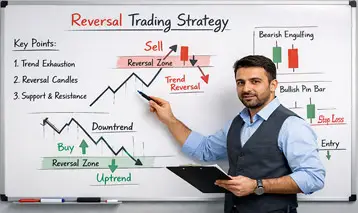
Financial markets do not move in a linear fashion. After a period of movement in one direction, prices gradually lose momentum and eventually change direction. These directional shifts are known as trend reversals.
Reversal trading is an approach that focuses on identifying the end of an existing trend and the beginning of a new one. The goal of this trading style is early entry into a newly forming trend whether the shift is from bearish to bullish or vice versa.
Unlike trend following strategies that move in the direction of the prevailing market trend, reversal traders attempt to capture the market’s turning point. This makes reversal trading potentially rewarding, but it also involves higher risk.
Occurs when a downtrend weakens and prices begin to rise. A reduction in selling pressure and increasing buyer strength are key characteristics of this type of reversal.
Forms at the end of an uptrend, where buying momentum fades and sellers gain control of the market.
Reversals can occur across all timeframes, but the higher the timeframe, the greater the reliability and strength of the reversal.
Identifying a true trend reversal is the most critical and most challenging aspect of reversal trading. Professional traders typically rely on a combination of techniques:
Certain price patterns frequently appear near the end of trends, including:
Many reversals occur near key support and resistance zones. Price reactions, failed breakouts, or strong rejections at these levels can signal a potential trend change.
A valid break of a major trendline followed by price failure to return above it often signals the end of the previous trend.
Divergence between price and indicators such as RSI or MACD typically indicates weakening momentum and an increased probability of reversal.
Reversals accompanied by increasing volume carry greater validity, as they suggest participation from larger market players.
To improve analytical accuracy, reversal traders often combine the following tools:
Look for areas where multiple technical factors align such as support or resistance combined with divergence.
Entering too early is one of the most common mistakes. Always wait for confirmation via candlestick behavior, structure breaks, or indicator signals.
Stop-loss and take profit levels must be defined before entry. Entering after a retest or observing a strong rejection reduces trade risk.
Due to the higher error rate in reversal trades, risk per trade should not exceed 1% of total capital, and the use of high leverage should be limited.
Brokers such as Exclusive Markets provide analytical tools and market data that can support more precise execution of such strategies provided sound risk management principles are followed.
Entering after a valid trendline break followed by rejection on the pullback.
Identifying divergence and entering only after structural breaks or valid candlestick patterns.
Focusing on major historical levels and strong price reactions in these zones.
Reversal trading is one of the most advanced trading styles and, when executed correctly, can offer highly attractive risk to reward ratios. However, false reversals, misleading signals, and elevated psychological pressure present serious challenges.
Combining technical analysis, deep price action understanding, multi layer confirmation, and disciplined risk management significantly improves the probability of success in reversal trading. When applied with knowledge and discipline, this strategy can become a powerful tool across forex, indices, commodities, and cryptocurrency markets.


