

Forex
+100 Assets
Content table
6 mounts ago
3 Minutes read
Written by Greenup24
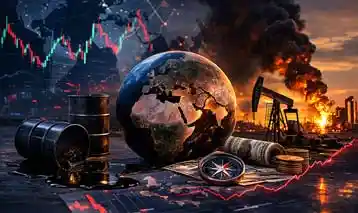
In recent months, global financial markets have been defined by a single word: uncertainty. Now, with escalating conflict in the Middle East and rising oil prices, a new concern is emerging among economists and investors alike — the possible return of stagflation.
Stagflation, a dangerous combination of high inflation and slow economic growth, was one of the most painful economic periods of the 20th century. The oil shocks of the 1970s pushed major economies into a cycle of rising prices, weak growth, and policy dilemmas that lasted for years.
Today, some analysts believe the global economy may once again be approaching similar conditions.
Tensions in the Middle East are not new. However, what is unfolding now resembles something far more serious — a full-scale regional conflict.
After decades of failed negotiations over Iran’s nuclear program, the United States and Israel launched coordinated military strikes aimed at dismantling Iran’s nuclear infrastructure. The conflict is now more than ten days in and continues to escalate, triggering volatility across global markets.
Oil prices have surged, risk sentiment has deteriorated, and investors are increasingly pricing geopolitical instability into financial assets.
But the roots of this crisis stretch further back.
The geopolitical chain reaction arguably began earlier in the year, when the United States announced a military operation in Venezuela that resulted in the capture of former president Nicolás Maduro and a political arrangement with the country's new leadership.
Following the operation, Venezuela’s oil sector was opened to American energy companies. The U.S. government also took a role in overseeing crude exports, with initial sales reportedly valued at $500 million, held in U.S.-controlled accounts.
These developments were widely interpreted as part of a broader effort by Washington to strengthen its influence over global energy supply.
Energy dominance has become a key geopolitical tool, especially amid intensifying strategic competition with China. Control over oil production, rare-earth resources, and energy supply chains increasingly shapes global power dynamics.
Even diplomatic initiatives surrounding Ukraine or discussions about acquiring strategic territories rich in natural resources are often analyzed within this broader geopolitical framework.
Rising geopolitical tensions in energy-producing regions almost always translate into higher oil prices. And historically, oil shocks act like a tax on the global economy.
When energy prices rise:
If these pressures persist while economic growth slows, the result can be stagflation — a situation that central banks struggle to manage.
Unlike typical recessions, stagflation creates a policy dilemma: raising interest rates may control inflation but further weaken growth, while lowering rates risks worsening inflation.
Central banks may be forced to keep interest rates higher for longer to control inflation, even as economic activity slows.
Equity markets have surged in recent years partly on expectations of lower borrowing costs. Persistent inflation could undermine that narrative and trigger major market corrections.
Investors may demand higher returns to compensate for inflation risk, pushing government bond yields upward.
Higher energy costs reduce disposable income and corporate margins, potentially weakening consumer spending and eventually impacting employment markets.
For policymakers in Washington, particularly the Trump administration, the preferred economic scenario is clear:
But prolonged conflict and elevated oil prices could derail that balance.
Adding to the pressure, the U.S. national debt continues to climb, while concerns about government funding and fiscal sustainability have surfaced multiple times in recent months.
A full stagflationary cycle is not yet inevitable. However, fear alone can move markets.
The decisive factor will likely be the duration of the Iran conflict and the trajectory of oil prices. The longer the conflict persists and the higher energy prices climb, the greater the risk that the current oil shock evolves into a broader stagflationary cycle.
Such a scenario would mark the first major return of stagflationary pressures since the late 1970s.
The global economy appears to be entering an era where geopolitics, energy markets, and macroeconomics are deeply intertwined.
The conflict in the Middle East is not merely a regional crisis; it may represent a turning point for global economic stability.
And history has repeatedly shown that energy shocks rarely remain confined to the energy sector — they reshape the entire economic landscape.


