

Forex
+100 Assets
Content table
4 mounts ago
3 Minutes read
Written by Greenup24
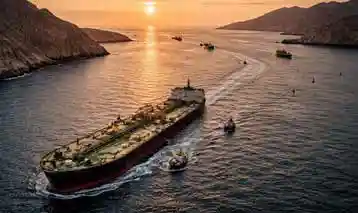
At first glance, the Strait of Hormuz may seem like just another narrow waterway in the Persian Gulf. In reality, this roughly 34 kilometer wide passage is one of the most vital arteries of the global economy. It serves as a critical link between major oil producers in the Middle East and key consumer markets across Asia, Europe, and North America, playing a decisive role in shaping energy prices worldwide.
The Strait of Hormuz connects the Persian Gulf to the Gulf of Oman and acts as the primary maritime gateway for oil exports from countries such as Saudi Arabia, Iraq, the United Arab Emirates, Kuwait, and Iran.
What makes it uniquely sensitive is its structure: shallow waters and tightly defined shipping lanes force vessels to navigate through extremely narrow corridors. This turns the strait into a strategic chokepoint where even minor disruptions can ripple across global trade.
Roughly 20% of the world’s traded oil and a significant portion of liquefied natural gas passes through this corridor every single day. Any disruption here directly impacts global supply.
A large share of these exports heads to Asian economies like China, India, and Japan. However, since oil is priced globally, any instability in this region affects markets everywhere, even in countries with domestic energy production.
Recent geopolitical tensions and military escalations have significantly reduced tanker traffic through the Strait of Hormuz. Attacks on oil infrastructure, ports, and refineries have disrupted production, tightening global supply.
At the same time, even limited security threats have driven insurance costs sharply higher. Many shipping companies have chosen to avoid the route altogether, amplifying the disruption.
Some regional producers have developed pipeline networks that bypass the Strait of Hormuz. However, these alternatives offer limited capacity and cannot fully replace maritime exports.
Moreover, moving oil beyond the strait does not guarantee safety. Alternative routes and export terminals can also be exposed to geopolitical risks, making the overall system vulnerable.
A drop in oil supply almost always leads to rising prices. While this may benefit certain exporting nations, it creates inflationary pressure for consumers and energy dependent economies.
Higher fuel costs translate into increased transportation expenses, production costs, and ultimately higher prices for goods and services. This is why a regional conflict in the Middle East can quickly evolve into a global economic shock.
For market participants, especially oil traders, the Strait of Hormuz is not just a geographic location; it is a critical risk factor.
It remains one of the world’s most sensitive geopolitical hotspots, where headlines alone can trigger sharp price movements. In today’s interconnected markets, even a 21 mile stretch of water can influence the direction of the global economy.


